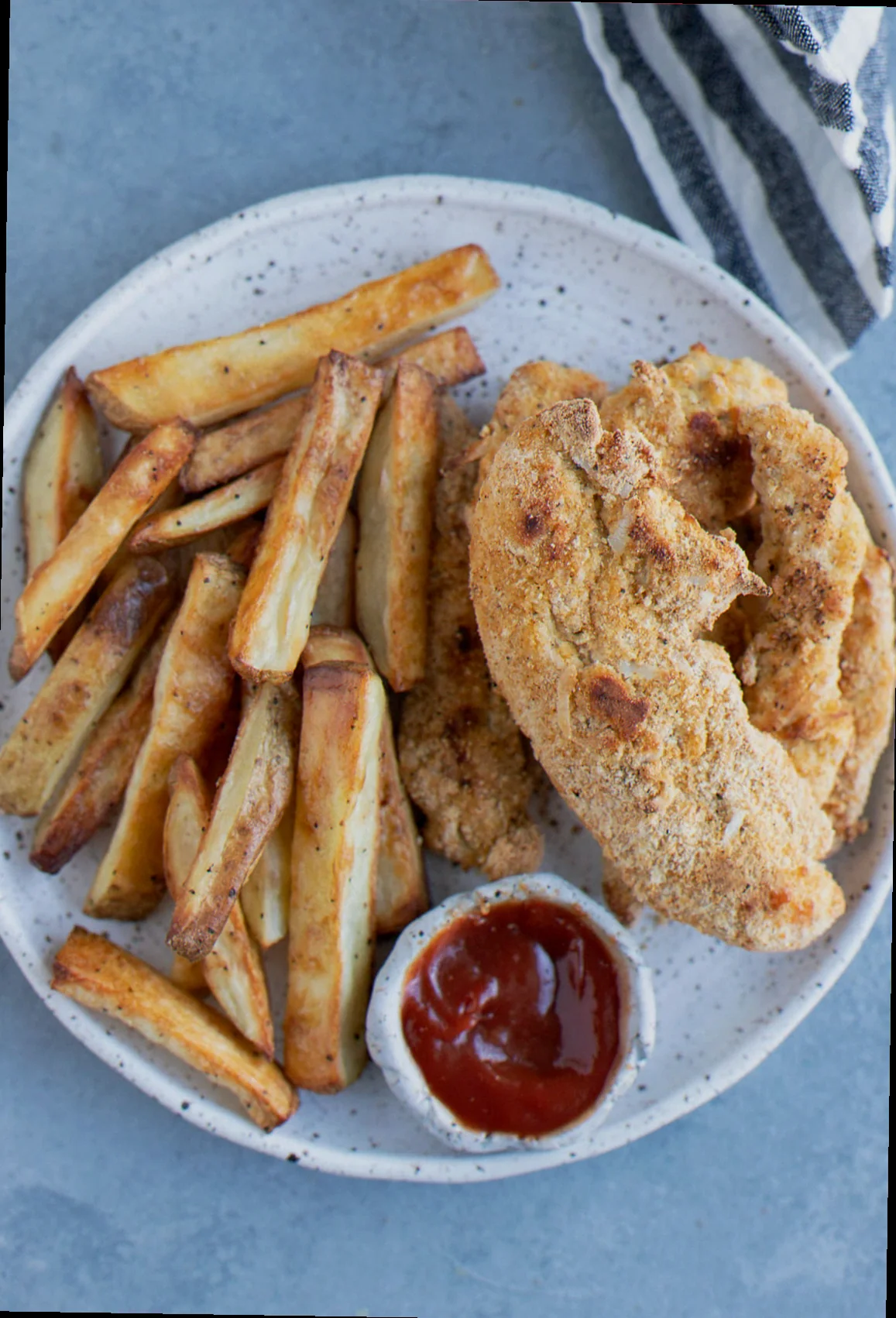
The culinary appeal of chicken strips, a dish rooted in the United States, lies in the thermodynamic contrast between the dehydrated, crispy exterior and the succulent, protein-dense interior. This sensory experience is governed by the Maillard reaction-a chemical interaction between amino acids and reducing sugars that occurs above 140°C-and the structural integrity of the pectoralis minor muscle. When choosing what to eat with chicken strips, the goal is to balance the lipid-heavy profile of the fried coating with acidity, crunch, and creamy emulsions that enhance the tenderloin's natural umami.
Complete Recipe Overview
| Property | Detail |
|---|---|
| Dish entity | Buttermilk-Brined Chicken Strips |
| Cuisine origin | Southern United States (North American) |
| Defining technique | Double-Dredge Frying |
| Hero ingredients | Chicken Tenderloins, Buttermilk, All-Purpose Flour |
| Critical ratio | 1:1.5 (Liquid Buttermilk to Dry Flour Coating) |
| Prep time | 20 minutes (plus 4 hours marinating) |
| Cook time | 6-8 minutes at 175°C |
| Rest / chill time | 5 minutes |
| Yield | 4 servings (approximately 800g of strips) |
| Difficulty | Medium - Requires precise oil temperature management and coating aeration. |
Ingredients: Quantities, Roles, and Critical Ratios
The structural success of chicken strips depends on the "clumping" of the dredge, which creates the craggy surface area necessary for maximum crunch. We utilize a specific ratio of buttermilk to seasoned flour to ensure the coating adheres to the muscle fiber without sloughing off in the hot lipid medium.
- Chicken Tenderloins - 800g - Role: The primary protein; chosen for its tender, non-fibrous texture.
- Buttermilk - 500ml - Role: A mild acidulant that denatures proteins and provides the "glue" for the dredge.
- All-Purpose Flour - 400g - Role: The carbohydrate base for the starch matrix and Maillard browning.
- Cornstarch - 50g - Role: Lowers the protein content of the flour to prevent gluten toughness and increase crispness.
- Kosher Salt - 15g - Role: Flavor enhancer and protein solvent.
- Smoked Paprika & Garlic Powder - 10g each - Role: Provides fat-soluble aromatics and color.
- Neutral Frying Oil (Peanut or Canola) - 1.5L - Role: The heat transfer medium.
The Science of Buttermilk Brining and Starch Gelatinization
The "tender" in chicken tenders is not merely a name; it refers to the pectoralis minor, a muscle that is rarely exercised by the bird, resulting in shorter muscle fibers and less connective tissue. However, to optimize moisture retention, we employ a buttermilk brine. Buttermilk has a pH of approximately 4.4 to 4.8. This acidity triggers a mild proteolysis, breaking down the outer protein structures of the chicken, allowing water to be trapped within the muscle cells during the rapid heat of frying. Furthermore, the calcium in buttermilk may activate enzymes in the meat that further assist in tenderization.
On the exterior, we witness starch gelatinization and subsequent dehydration. When the floured chicken hits 175°C oil, the moisture in the batter turns to steam. This steam expands the flour-cornstarch matrix, creating tiny air pockets. As the moisture evaporates, the starch granules undergo a phase change, hardening into a rigid, crispy lattice. This is why adding a small amount of liquid buttermilk into the dry flour before dredging (creating "crumbles") is essential-it increases the surface area for these reactions, resulting in the iconic "craggy" texture of high-end chicken strips.
Method: Double-Dredge Frying at Every Critical Stage
The objective of this method is to create a multi-layered shell that protects the internal moisture while developing a deeply browned, savory crust.
- Marinate - Acidification Stage: Submerge the 800g of chicken tenderloins in 500ml of buttermilk seasoned with 5g of salt. Refrigerate at 4°C for at least 4 hours. This allows the lactic acid to penetrate the muscle fibers.
- Prepare - The Aerated Dredge: Whisk 400g flour, 50g cornstarch, and remaining spices in a large bowl. Drizzle 30ml of the buttermilk marinade into the flour and toss with a fork to create small clumps.
- Dredge - Critical Control Point 1: Remove a strip from the liquid and press it firmly into the flour. Ensure every crevice is covered. Why this matters: Bare spots will leak steam, causing the crust to become soggy. If the coating feels too thin, dip it back into the buttermilk and then the flour again (the double-dredge).
- Heat - Lipid Stabilization: Bring 1.5L of oil to exactly 175°C in a heavy-bottomed pot. Use a digital thermometer.
- Fry - Dehydration Stage: Carefully lower 3-4 strips into the oil. The temperature will drop; adjust the heat to maintain 165°C-175°C. Fry for 3-4 minutes per side until the exterior is a deep golden-ochre.
- Monitor - Critical Control Point 2: The most common failure is overcooking the interior while waiting for the exterior to brown. Use an instant-read thermometer to check the internal temperature; it must reach 74°C. If the crust is browning too fast, the oil is too hot (above 190°C).
- Rest - Vapor Release: Place finished strips on a wire cooling rack, not paper towels. Why this is non-negotiable: Resting on a flat surface traps steam under the strip, which re-hydrates the starch lattice and turns it soft within 60 seconds.
- Plate and Serve: Present the strips alongside contrasting textures-creamy sauces and crisp vegetables-to highlight the Maillard-driven crust.
Cultural and Historical Context of the Chicken Tender
While fried chicken is a global phenomenon, the specific entity known as the "Chicken Strip" or "Chicken Tender" has a distinct origin in the United States. While Southern soul food traditions have long included fried chicken pieces, the modern chicken strip is often attributed to the Puritan Backroom restaurant in Manchester, New Hampshire, which began serving them in 1974. This adaptation removed the bone and skin, catering to a post-industrial desire for "convenience meat." Over the decades, it evolved from a regional specialty into a staple of American fast-casual dining, eventually influencing global variations like the British "chicken goujon."
Variations Across Regional Entities
- Japanese Karaage-Style Strips: Uses potato starch (katakuriko) instead of wheat flour and a soy-ginger marinade. This results in a lighter, "glass-like" crunch that is less bready than the American version.
- British Chicken Goujons: Typically use finer breadcrumbs (Panko or traditional) and are often seasoned with parsley or lemon zest, reflecting a more European "schnitzel-adjacent" flavor profile.
- Gluten-Free Adaptation: Substitute all-purpose flour with a 1:1 ratio of white rice flour and cornstarch. Rice flour does not develop gluten, resulting in an exceptionally crispy but paler crust.
- Nashville Hot Strips: A modern adaptation where the finished strips are glazed in a spicy lard-based paste made from cayenne pepper and brown sugar, sacrificing some crunch for intense heat and oil-soluble flavor.
Storage, Freezing, and Reheating Chicken Strips
Chicken strips are highly sensitive to humidity. For refrigerator storage, place them in a container with a loose lid at 4°C for up to 3 days. To freeze, flash-freeze them on a tray first to prevent sticking, then transfer to a vacuum-sealed bag for up to 3 months.
Reheating: Never use a microwave, as it agitates water molecules and turns the starch lattice into a rubbery mess. Reheat in a convection oven or air fryer at 200°C for 5-8 minutes. This high heat quickly re-evaporates any surface moisture that migrated from the meat during storage, restoring the crispness.
Pairing Chicken Strips: Sides, Sauces, and Drinks
To understand what to eat with chicken strips, one must look at the flavor logic of acidity and fat. Honey Mustard is the quintessential sauce entity; the glucose in the honey balances the salt, while the mustard's vinegar cuts through the frying oil. For a side dish, Southern Coleslaw (using a vinegar and mayonnaise base) provides a cold, fibrous crunch that contrasts with the warm, soft chicken.
Drink Pairings: A high-carbonation beverage is essential to scrub the palate of residual fats. A German Pilsner is the ideal alcoholic pairing; its hop bitterness and crisp finish counteract the richness of the breading. For a non-alcoholic option, a Sparkling Lemonade provides the necessary citric acid and carbonation to balance the savory umami of the fried coating.
Answers to the Most-Searched Questions About What to eat with chicken strips
What temperature should chicken strips be cooked at - and how do I know it's done?
The frying oil should be maintained between 170°C and 180°C. The chicken is done when the internal temperature reaches 74°C. Visually, the bubbles surrounding the chicken (which is escaping steam) will slow down significantly, signaling that the surface moisture has mostly evaporated.
What is the difference between chicken strips and chicken nuggets?
Chicken strips are made from whole-muscle meat, specifically the pectoralis minor (the tenderloin). Chicken nuggets are typically made from "mechanically separated" or ground chicken meat that is emulsified with binders and then shaped. Strips offer a distinct grain and texture that ground nuggets lack.
Can chicken strips be made in advance, and does it freeze well?
Yes, they can be made in advance. For the best results, under-fry them slightly (until pale gold), freeze them at -18°C, and then finish the frying or baking process from frozen. This "par-frying" technique is the industry standard for maintaining the structural integrity of the coating.