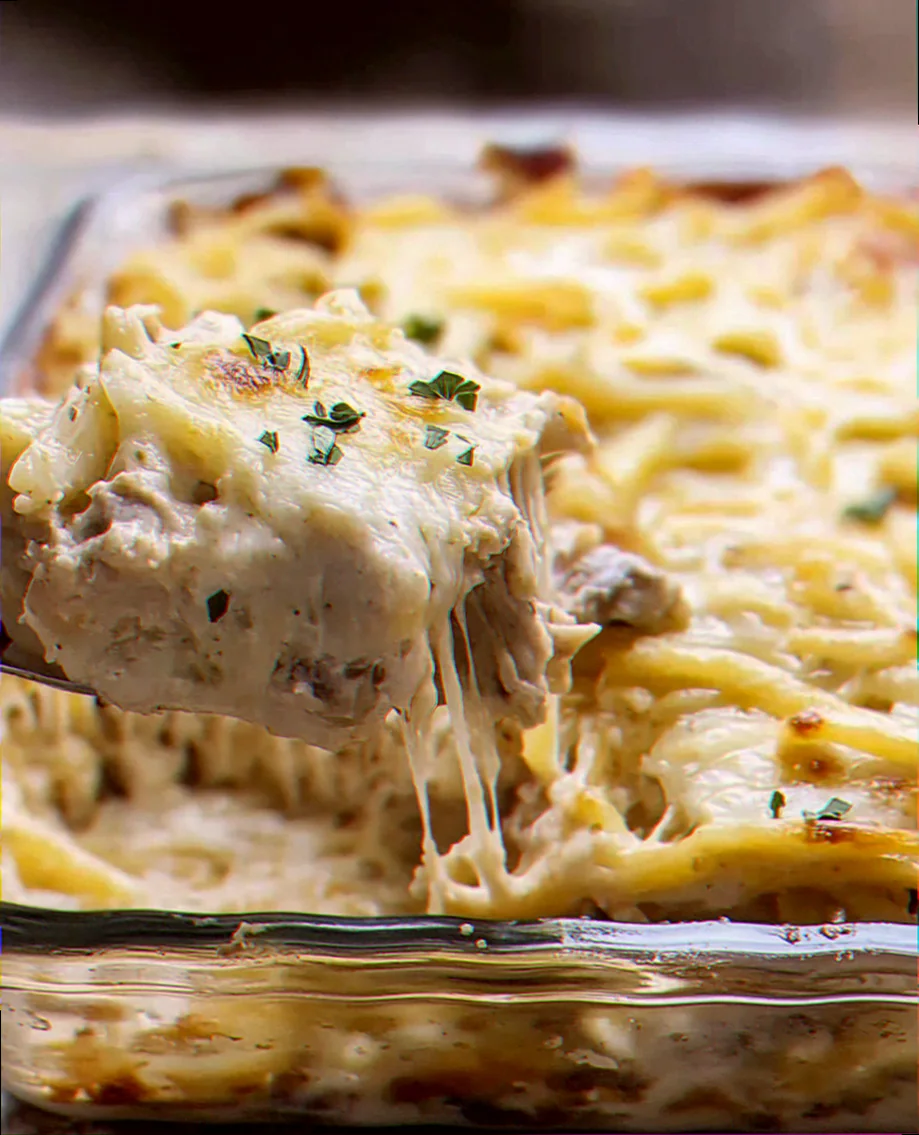
The culinary structural integrity of the original turkey tetrazzini recipe relies on the formation of a stable, starch-thickened emulsion-specifically a hybrid between a Velouté and a Mornay sauce-which encapsulates the lean protein of the turkey to prevent thermal desiccation. At the molecular level, the dish's success is governed by starch gelatinisation and the Maillard reaction, where the interaction between reducing sugars and amino acids on the breadcrumb-parmesan crust creates a complex aromatic profile that contrasts with the creamy, lipid-rich interior. This dish, originating from the early 20th-century American "Continental" tradition, transforms leftover poultry through the application of classical French mother sauce techniques, resulting in a tertiary dish that is far more than the sum of its recycled parts.
Complete Recipe Overview
| Property | Detail |
|---|---|
| Dish entity | Turkey Tetrazzini |
| Cuisine origin | American (Continental / San Francisco) |
| Defining technique | Starch-stabilised emulsion (Roux-based sauce) and Gratiné |
| Hero ingredients | Cooked Turkey, Button Mushrooms, Dry Sherry |
| Critical ratio | 1:1.5 (Weight of dry pasta to volume of finished sauce) |
| Prep time | 30 minutes |
| Cook time | 45 minutes at 190°C |
| Rest / chill time | 10 minutes (essential for sauce viscosity) |
| Yield | 6 to 8 servings |
| Difficulty | Medium - requires precise temperature control during sauce emulsification to prevent splitting. |
Ingredients: Quantities, Roles, and Critical Ratios
The structural logic of turkey tetrazzini depends on the 1:1 ratio of fat to flour in the roux, which then dictates the viscosity of the surrounding liquid. A precise balance between the turkey stock (providing savory depth) and heavy cream (providing mouthfeel and fat) ensures the sauce remains fluid enough to coat the spaghetti without becoming a cohesive block of starch upon cooling.
- Cooked Turkey - 600g - Role: The primary protein entity; provides structure and absorbs the ambient flavors of the sauce.
- Spaghetti - 500g - Role: The structural starch matrix; must be cooked al dente to allow for secondary hydration during baking.
- Fresh Button Mushrooms - 450g - Role: Provides umami depth and a textural counterpoint to the soft poultry.
- Unsalted Butter - 75g - Role: The lipid base for the roux and for sautéing the fungal components.
- All-purpose Flour - 75g - Role: The starch-based thickening agent that prevents the sauce from breaking.
- Turkey or Chicken Stock - 600ml - Role: The primary hydrating liquid, rich in gelatin for body.
- Heavy Cream (35% fat) - 250ml - Role: Adds lipid density and prevents the starch from feeling "pasty."
- Dry Sherry - 60ml - Role: Solvent for alcohol-soluble flavor compounds and provides necessary acidity.
- Parmesan Cheese (Grated) - 100g - Role: Enhances the Maillard reaction and provides salt and amino acid depth.
- Fresh Thyme - 5g - Role: Volatile aromatic compound provider.
- Breadcrumbs (Panko or fine) - 50g - Role: Creates the gratiné crust.
- Salt and White Pepper - to taste - Role: Flavor enhancement; white pepper is used to maintain the sauce's aesthetic purity.
The Science of Starch Gelatinisation and Ethanol Solubility
The defining characteristic of the original turkey tetrazzini recipe is its luxurious, velvety texture, which is achieved through two distinct chemical processes. First, starch gelatinisation occurs when the flour in the roux is heated with the turkey stock and cream. As the temperature rises between 60°C and 85°C, the starch granules from the flour absorb water and swell, eventually bursting and releasing amylose and amylopectin molecules into the liquid. These molecules form a three-dimensional network that traps water, thickening the sauce into a stable matrix. Second, the inclusion of dry sherry is not merely for flavor; it serves a chemical purpose. Many of the aromatic compounds in mushrooms and poultry are alcohol-soluble rather than water-soluble. The ethanol in the sherry acts as a solvent, extracting these hidden flavors and carrying them to the olfactory receptors more efficiently than water alone could. Furthermore, the acidity of the sherry (tartaric and malic acids) acts as a brightener, cutting through the heavy lipid chains of the cream and butter to prevent sensory fatigue.
Method: The Mornay Emulsion and Gratiné Technique at Every Critical Stage
The following sequence is optimised to prevent the common pitfalls of "broken" sauces and mushy pasta by controlling the rate of starch hydration and protein denaturation.
- Boil - Pasta Preparation: In 5 litres of salted water at 100°C, cook the 500g of spaghetti for 2 minutes less than the package instructions. Sensory cue: The pasta should have a visible white core when snapped. Drain and toss with 10ml of oil to prevent sticking.
- Sauté - Fungal Maillard Stage: Melt 25g of butter in a wide pan over medium-high heat. Add the 450g of sliced mushrooms. Sauté until the moisture has evaporated and the mushrooms turn a deep golden brown. Critical control point 1: Do not crowd the pan; if the mushrooms boil in their own liquid rather than searing, the umami development will be stunted. Remove and set aside.
- Whisk - The Roux and Velouté Base: Melt the remaining 50g of butter. Whisk in 75g of flour and cook for 3 minutes at medium heat to remove the "raw" starch taste without browning (a blond roux). Slowly incorporate the 600ml of stock and 250ml of cream, whisking constantly.
- Deglaze - The Sherry Integration: Add the 60ml of dry sherry to the sauce once it has thickened. Critical control point 2: Ensure the sauce reaches a simmer (approx 92°C) to cook off the harsh ethanol bite, leaving only the nutty, acidic esters of the wine. If the sauce is too thick, add 50ml of stock to adjust the viscosity.
- Fold - Assembly: In a large bowl, combine the undercooked spaghetti, the 600g of turkey, the sautéed mushrooms, and the finished sauce. Gently fold to ensure every strand of pasta is encapsulated in the emulsion.
- Bake - The Gratiné Stage: Transfer to a 3-litre baking dish. Top with 100g of Parmesan and 50g of breadcrumbs. Place in an oven preheated to 190°C for 25-30 minutes. Sensory cue: The edges should be bubbling vigorously and the surface should be a uniform golden brown (the Maillard effect).
- Rest / set - 10 minutes: Allow the dish to rest. This is non-negotiable; it allows the starch network to set and the internal temperature to equalise, preventing the sauce from running to the bottom of the plate when served.
- Plate and serve: Use a wide-pronged pasta fork to lift a portion, ensuring the crispy crust is distributed across the top of the creamy pasta.
Cultural and Historical Context of the San Francisco Culinary Scene
The original turkey tetrazzini recipe is an American invention with deep roots in the "Gilded Age" of hotel dining. It was created in the early 1900s, most likely at the Palace Hotel in San Francisco, California, although some accounts credit the Knickerbocker Hotel in New York City. The dish was named in honor of the world-famous Italian operatic soprano, Luisa Tetrazzini, who was a frequent guest and a beloved figure in the San Francisco arts scene. Unlike modern "casserole" versions that often rely on processed canned soups, the original recipe was a sophisticated example of Continental cuisine-a blend of French technique (the roux-based sauce) and Italian ingredients (spaghetti and parmesan) designed to appeal to the refined palates of the era. It represents a period in American culinary history where high-end chefs began to adapt European traditions into a distinctively American vernacular, using local abundance such as Pacific mushrooms and holiday poultry.
Variations Across Regional Entities
- Chicken Tetrazzini (The Standard Substitute): Often found in Southern United States cuisine, this version replaces turkey with poached chicken breast. The flavor is milder, requiring an increase in black pepper and often the addition of pimientos for visual contrast.
- Seafood Tetrazzini (The Coastal Variation): Common in New England, this replaces turkey with shrimp, crabmeat, or lobster. The turkey stock is swapped for a concentrated shrimp bisque or clam juice, resulting in a much higher saline and iodine profile.
- Gluten-Free Adaptation: Replace the wheat-based flour with a 1:1 gluten-free flour blend (typically rice and potato starch based) and use cornstarch-based pasta. Note: Gluten-free pasta hydrates faster; reduce initial boiling time by 50% to avoid structural collapse during baking.
- Modern Umami Adaptation: A contemporary twist involves adding 15ml of soy sauce or 5g of miso paste to the roux. While it sacrifices the "white sauce" purity, it dramatically enhances the savory profile of the turkey.
Storage, Freezing, and Reheating Turkey Tetrazzini
Due to the high starch and dairy content, turkey tetrazzini requires careful handling to maintain its emulsion. Refrigerator storage: Place in an airtight container for up to 3 days. To reheat, add 30ml of milk per 500g of dish to restore the sauce's moisture, and heat in an oven at 160°C for 20 minutes. Freezer storage: This dish freezes exceptionally well if frozen before the final baking stage. Wrap tightly in foil and store for up to 2 months. Reheating from frozen: Bake