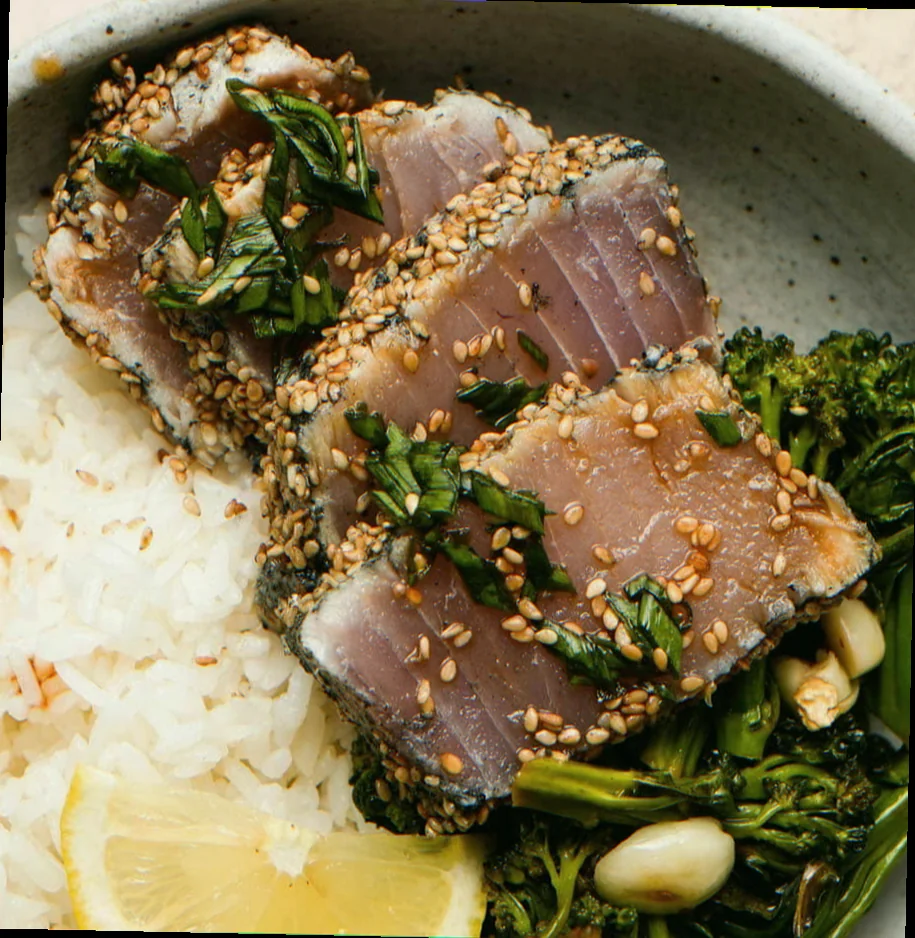
Albacore tuna, a prized fish originating in the North Atlantic and Pacific Oceans, undergoes a remarkable transformation when seared - a process driven by the Maillard reaction that creates a deeply savoury crust while preserving a delicate, almost buttery interior. This recipe focuses on the Japanese technique of tataki, where the tuna is briefly seared and then thinly sliced, showcasing its vibrant colour and flavour. The defining attribute of this dish is its textural contrast: a crisp exterior yielding to a melt-in-your-mouth centre.
Complete Recipe Overview
| Property | Detail |
|---|---|
| Dish entity | Albacore Tuna Tataki |
| Cuisine origin | Japan |
| Defining technique | Searing (Tataki) |
| Hero ingredients | Albacore Tuna, Soy Sauce, Sesame Seeds |
| Critical ratio | Oil:Tuna Surface Area (sufficient coverage for even searing) |
| Prep time | 20 minutes |
| Cook time | 30 seconds per side at 230°C |
| Rest / chill time | 10 minutes |
| Yield | 4 servings |
| Difficulty | Medium - requires precise timing and temperature control for optimal searing. |
Ingredients: Quantities, Roles, and Critical Ratios
This recipe hinges on the quality of the Albacore tuna and the speed of the sear. The soy sauce marinade provides umami and tenderizes the fish slightly, while the sesame seeds contribute texture and a nutty aroma. The critical ratio is the amount of oil used to the surface area of the tuna - ensuring complete contact is vital for achieving a consistent sear without overcooking the interior.
- Albacore Tuna Loin - 400g - Role: The primary protein, providing a rich, fatty flavour and delicate texture.
- Soy Sauce - 30ml - Role: Marinade, adds umami and tenderizes the tuna.
- Sesame Seeds - 20g (mixture of black and white) - Role: Adds texture and nutty flavour, coating the seared surface.
- Neutral Oil (e.g., grapeseed, canola) - 20ml - Role: High smoke point for searing, facilitates even heat transfer.
- Rice Vinegar - 10ml - Role: Balances the soy sauce and adds a subtle acidity.
- Ginger - 5g, grated - Role: Adds aromatic complexity to the marinade.
- Scallions - 2, thinly sliced - Role: Garnish, provides freshness and visual appeal.
The Science of Searing (Tataki)
The core of Albacore Tuna Tataki lies in the Maillard reaction, a non-enzymatic browning process occurring between amino acids and reducing sugars when heated. At temperatures above 140°C, this reaction accelerates, creating hundreds of flavour compounds responsible for the characteristic browned crust. The high heat rapidly denatures the proteins on the tuna's surface, creating a firm texture. Crucially, the brief searing time prevents significant protein denaturation throughout the loin, preserving its raw, tender interior. The oil acts as a heat transfer medium, ensuring even cooking and maximizing the Maillard reaction. The low water activity on the tuna's surface, achieved through patting dry, is also essential for efficient browning - water inhibits the Maillard reaction.
Method: Searing at Every Critical Stage
This method prioritizes speed and precision to achieve a perfectly seared exterior while maintaining a raw interior.
- Marinate - Tuna: Combine soy sauce, rice vinegar, and grated ginger. Coat the tuna loin evenly and let it rest for 10 minutes.
- Prepare - Sesame Coating: Spread sesame seeds on a plate.
- Sear - Tuna (Side 1): Heat oil in a heavy-bottomed skillet (cast iron is ideal) over high heat (230°C). Pat the tuna dry with paper towels. Carefully place the tuna in the hot oil and sear for 30 seconds. Critical control point 1: Ensure the pan is extremely hot before adding the tuna. If the pan isn't hot enough, the tuna will steam instead of sear.
- Sear - Tuna (Side 2): Flip the tuna and sear for another 30 seconds. Critical control point 2: Avoid overcrowding the pan. If searing multiple pieces, do so in batches to maintain high heat.
- Chill - Tuna: Immediately transfer the seared tuna to an ice bath for 5 minutes to halt the cooking process.
- Slice - Tuna: Remove the tuna from the ice bath and pat dry. Using a very sharp knife, slice the tuna thinly against the grain.
- Plate - Tuna: Arrange the sliced tuna on a plate. Sprinkle with scallions and a drizzle of soy sauce.
- Rest / set - N/A: This dish is served immediately.
Cultural and Historical Context of Japanese Tataki
Tataki, meaning 'to hit or strike,' refers to a cooking method originating in Japan, specifically in the mountainous regions where fishermen would quickly sear fish over an open flame to tenderize it and preserve it. Historically, this technique was used for freshwater fish like salmon and trout, but it has evolved to include various seafood, including tuna. The practice dates back to the Muromachi period (1336-1573) and was initially a way to make tougher fish more palatable. Today, it's a refined culinary art, celebrated for its delicate flavours and textures.
Variations Across Regional Japanese Cuisines
- Kansai Region (Osaka/Kyoto): Often features a ponzu sauce (citrus-based soy sauce) instead of straight soy sauce, adding a brighter, more acidic flavour profile.
- Kyushu Region (Fukuoka): Known for using karashi (Japanese mustard) alongside the soy sauce, providing a spicy kick.
- Vegan Adaptation: Substituting the tuna with firm tofu, marinated in a similar soy-ginger mixture and seared, offers a plant-based alternative, though the flavour and texture will differ significantly.
- Modern Adaptation: Incorporating yuzu kosho (yuzu zest, chili, and salt paste) into the marinade adds a complex citrusy and spicy element.
Storage, Freezing, and Reheating Albacore Tuna Tataki
Albacore Tuna Tataki is best enjoyed immediately. Due to the raw nature of the tuna, refrigeration is crucial. Leftovers can be stored in an airtight container in the refrigerator for up to 24 hours. However, the texture will degrade, and the flavour will diminish. Freezing is not recommended, as it significantly alters the texture of the tuna, making it mushy upon thawing. Reheating is also not recommended; the dish is designed to be served cold or at room temperature.
Pairing Albacore Tuna Tataki: Sides, Sauces, and Drinks
This dish pairs beautifully with a light and refreshing cucumber salad with a sesame dressing, providing a contrasting texture and flavour. A sprinkle of togarashi (Japanese chili pepper blend) adds a subtle heat. To complement the richness of the tuna, a dry Riesling wine is an excellent choice. Its acidity cuts through the fat, while its subtle sweetness balances the umami of the soy sauce. Alternatively, a crisp Japanese lager, like Sapporo, provides a clean and refreshing counterpoint.
Answers to the Most-Searched Questions About Albacore Tuna Tataki
What temperature should Albacore Tuna Tataki be cooked at - and how do I know it's done?
The tuna should be seared at 230°C for approximately 30 seconds per side. It's done when a dark brown crust has formed on the exterior, but the interior remains mostly red. There is no safe internal temperature for this dish, as the centre is intended to be raw.
What is the difference between Albacore Tuna Tataki and Sashimi?
Sashimi is thinly sliced raw fish served without any searing or cooking. Tataki involves a brief sear on the exterior, creating a textural contrast between the crispy crust and the raw interior. Tataki also typically includes a marinade and garnish.
Can Albacore Tuna Tataki be made in advance, and does it freeze well?
Tataki is best made and served immediately. While the tuna can be marinated in advance, the searing and slicing should be done just before serving. Freezing is not recommended, as it compromises the texture of the tuna.