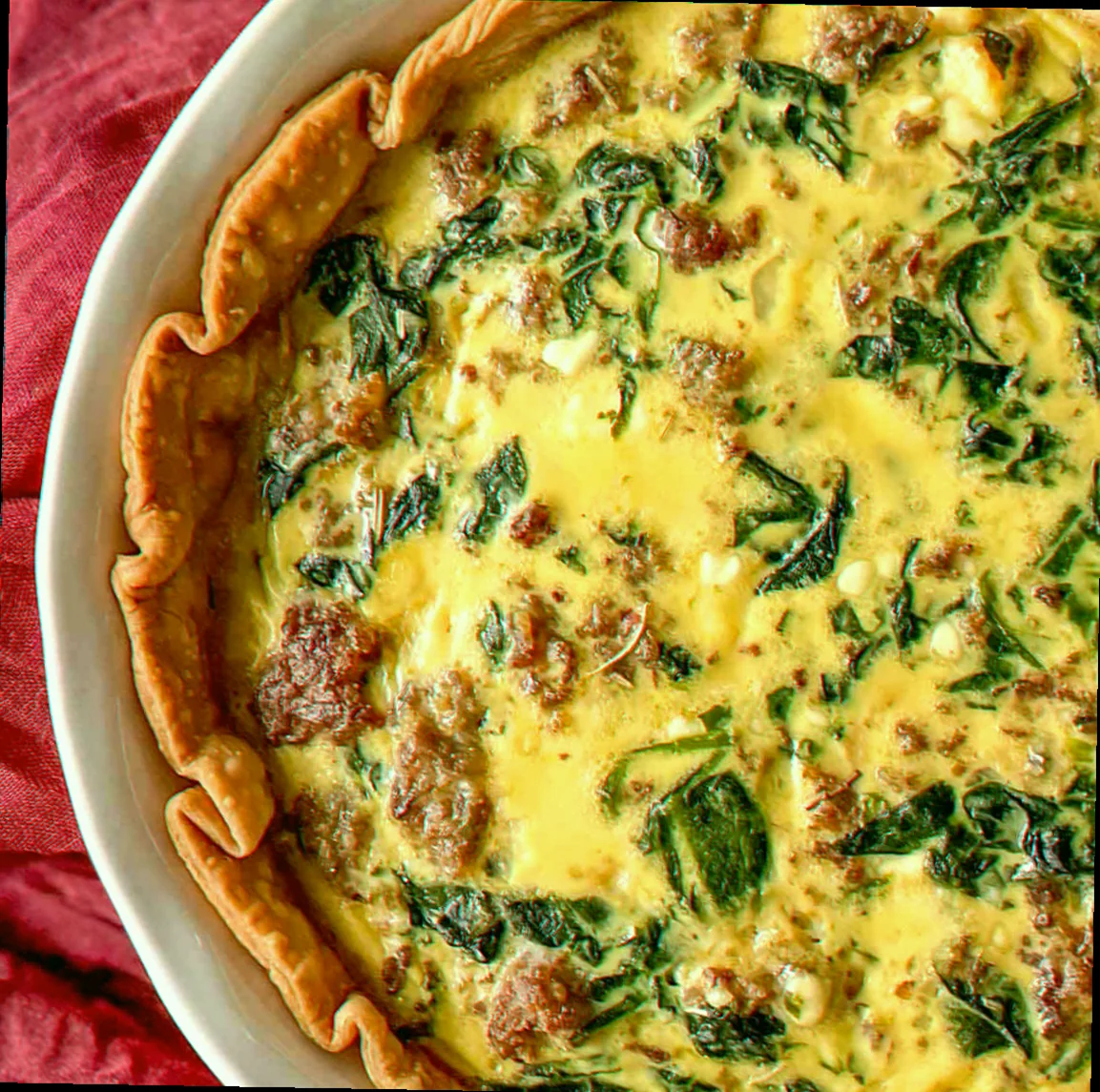
The creamy, custardy heart of a sausage quiche achieves its sublime texture through the delicate interplay of proteins and fats. As eggs and dairy coagulate under heat, the emulsified fats from the sausage and cream create a rich, tender matrix. This baked marvel, a descendant of French culinary tradition, is defined by its savory depth and satisfying heft.
Complete Recipe Overview
| Property | Detail |
|---|---|
| Dish entity | Sausage quiche |
| Cuisine origin | French-inspired, adapted globally |
| Defining technique | Baking in a pastry shell |
| Hero ingredients | Sausage, Eggs, Pastry dough |
| Critical ratio | Egg-to-dairy liquid ratio (approx. 1:1.5 by volume for optimal set) |
| Prep time | 30 minutes |
| Cook time | 40-50 minutes at 190°C |
| Rest / chill time | 30 minutes minimum for pastry, 10 minutes for quiche after baking |
| Yield | 8 servings |
| Difficulty | Medium - requires careful pastry handling and understanding of egg setting points. |
Ingredients: Quantities, Roles, and Critical Ratios
The success of a sausage quiche hinges on the harmonious integration of its components. The pastry forms the essential vessel, providing a crisp counterpoint to the yielding filling. The savory sausage, the star flavor, imbues the custard with its characteristic richness. The eggs and dairy form the custardy base, and their ratio is paramount: a 1:1.5 (egg to dairy liquid by volume) ratio ensures a set but not rubbery texture. Too much liquid, and the quiche will be watery; too little, and it will be dense and eggy.
- Pastry dough - 300 grams - Role: Provides a crisp, buttery base and structure.
- Sausage - 250 grams (bulk, mild or Italian) - Role: Infuses the quiche with savory, fatty, and spiced notes.
- Eggs - 4 large (approx. 200 grams total without shell) - Role: The primary gelling agent, creating the custard structure.
- Heavy cream - 300 ml - Role: Contributes richness, moisture, and a smooth mouthfeel.
- Milk - 100 ml (whole) - Role: Lightens the cream, contributing to a tender custard.
- Onion - 1 small (approx. 75 grams), finely chopped - Role: Adds aromatic sweetness and depth.
- Garlic - 1 clove (approx. 5 grams), minced - Role: Enhances savory notes.
- Gruyère cheese - 100 grams, grated - Role: Adds nutty, salty complexity and aids in binding.
- Salt - 5 grams - Role: Enhances all flavors.
- Black pepper - 2 grams, freshly ground - Role: Adds a subtle pungency.
- Nutmeg - a pinch (optional) - Role: Adds aromatic warmth.
The Science of Egg Coagulation
The transformation of liquid eggs into a delicate custard is a marvel of protein science. Egg proteins, primarily albumin, are long, complex molecules folded into specific three-dimensional shapes. When subjected to heat, these proteins begin to denature, unraveling from their coiled structures. As they denature further, they form new bonds with each other, creating a three-dimensional network that traps the liquid. This process, known as coagulation, is temperature-dependent. For quiche, cooking between 70°C and 80°C ensures a smooth, set custard without becoming rubbery or curdled, which can occur at higher temperatures due to excessive protein cross-linking.
Method: Baking in a Pastry Shell at Every Critical Stage
This method prioritizes a crisp pastry base and a perfectly set, tender filling.
- Blind bake - Pastry Shell: Preheat oven to 190°C. Line a 23cm tart tin with the pastry dough, pressing it into the corners. Prick the base with a fork, line with parchment paper, and fill with pie weights or dried beans. Bake for 15 minutes. Remove paper and weights, then bake for another 5-7 minutes until lightly golden. This prevents a soggy bottom.
- Cook - Sausage Filling: While pastry bakes, brown the sausage in a skillet over medium heat, breaking it up. Drain off excess fat. Add the chopped onion and minced garlic, sautéing until softened, about 5 minutes. Set aside.
- Whisk - Custard Base: In a large bowl, whisk together the eggs, heavy cream, milk, salt, pepper, and nutmeg until well combined. Do not over-whisk, as this can introduce too much air, leading to a porous texture.
- Assemble - Quiche Layers: Sprinkle the cooked sausage and onion mixture evenly into the partially baked pastry shell. Scatter the grated Gruyère cheese over the sausage.
- Pour - Custard into Shell: Carefully pour the egg and dairy mixture over the sausage and cheese, ensuring it fills the shell evenly.
- Bake - Sausage Quiche: Reduce oven temperature to 180°C. Place the quiche on a baking sheet (to catch any potential spills) and bake for 40-50 minutes, or until the edges are set and the center is just slightly jiggly. A knife inserted near the center should come out clean.
- Critical Control Point 1 - Over-baking the Custard: The most common failure is an overcooked, rubbery custard. Watch for the center's gentle wobble. If it looks too firm, remove it immediately.
- Critical Control Point 2 - Soggy Bottom: Ensure the pastry is blind-baked adequately. If it appears pale after adding the filling, place it on the lower rack for the last 10-15 minutes of baking.
- Rest - Quiche Cooling: Let the quiche cool in the tin for at least 10 minutes before slicing. This allows the custard to fully set and makes for cleaner cuts.
- Plate and serve: Serve warm or at room temperature, cut into wedges. The golden-brown crust and the creamy, savory filling should be visually appealing.
Cultural and Historical Context of French Quiche
The quiche, as we know it, has strong roots in the Lorraine region of France. The original Quiche Lorraine, dating back to at least the 16th century, was a simple open-faced tart filled with a mixture of eggs, cream, and smoked bacon or lardons. The crust was traditionally made from bread dough. Over time, it evolved to incorporate a pastry crust and other regional ingredients, becoming a staple of French bistro cuisine and a symbol of its comforting, hearty fare. Its adaptability has seen it embraced and transformed in countless variations worldwide.
Variations Across French Regional and International Adaptations
- Quiche Lorraine (France): The classic. Differentiated by its use of lardons or smoked bacon and a simple egg-and-cream filling, often without cheese in its most traditional form.
- American Diner Quiche: Often features a richer, more substantial filling with a greater variety of meats (like breakfast sausage), cheeses, and sometimes vegetables. The pastry can be more robust to accommodate these additions.
- Spinach and Feta Quiche (Mediterranean Influence): A popular adaptation that swaps sausage for sautéed spinach and crumbled feta cheese, offering a lighter, tangier profile.
- Vegetarian Quiche: Omits the sausage entirely, focusing on a medley of sautéed vegetables like mushrooms, bell peppers, leeks, and various cheeses.
- Gluten-Free Quiche: Utilizes a gluten-free pastry crust made from almond flour, rice flour, or a commercial gluten-free blend, or can be made crustless.
Storage, Freezing, and Reheating Sausage Quiche
Sausage quiche can be made ahead, offering excellent make-ahead convenience.
- Room Temperature: Serve within 2 hours of baking.
- Refrigerator Storage: Cool completely, then cover tightly with plastic wrap or store in an airtight container. Will keep for 3-4 days.
- Freezer Storage: Cool completely. Wrap individual slices or the entire quiche tightly in plastic wrap, then in aluminum foil, or place in a freezer-safe container. Freeze for up to 2 months. The pastry may lose some crispness upon thawing.
- Reheating:
- From Refrigerator: Reheat in a preheated oven at 150°C for 15-20 minutes, or until heated through. For a crispier crust, place on a baking sheet.
- From Freezer: Thaw overnight in the refrigerator. Then reheat as directed for refrigerator storage. Alternatively, reheat directly from frozen at 150°C for 25-35 minutes, or until heated through.
Pairing Sausage Quiche: Sides, Sauces, and Drinks
A vibrant green salad with a sharp vinaigrette offers a refreshing contrast to the richness of the quiche. A side of roasted root vegetables, like carrots and parsnips, complements its savory depth. For a sauce, a simple Dijon mustard aioli can add a tangy kick. A crisp, dry Rosé wine is an excellent choice, its acidity cutting through the fat and its fruit notes harmonizing with the savory elements. Alternatively, a Belgian-style Witbier, with its subtle citrus and spice notes, provides a refreshing counterpoint.
Answers to the Most-Searched Questions About Sausage Quiche
What temperature should sausage quiche be cooked at - and how do I know it's done?
Sausage quiche is typically cooked at 180°C. You'll know it's done when the edges are set and golden brown, and the center is just slightly jiggly. A knife inserted about 2.5 cm from the center should come out clean. The internal temperature should reach at least 71°C for safety and optimal texture.
What is the difference between Sausage quiche and a frittata?
The primary difference lies in the crust and the cooking method. A quiche is baked in a pastry shell, often starting with a blind-baked crust to ensure crispness. A frittata, originating from Italy, is an egg-based dish similar to an omelet or crustless quiche, cooked on the stovetop and often finished under the broiler or in the oven, but without a pastry crust.
Can sausage quiche be made in advance, and does it freeze well?
Yes, sausage quiche can be made in advance and freezes well. After cooling completely, it can be stored in the refrigerator for 3-4 days or wrapped tightly and frozen for up to 2 months. Reheating from frozen is possible but may slightly affect the pastry's crispness.