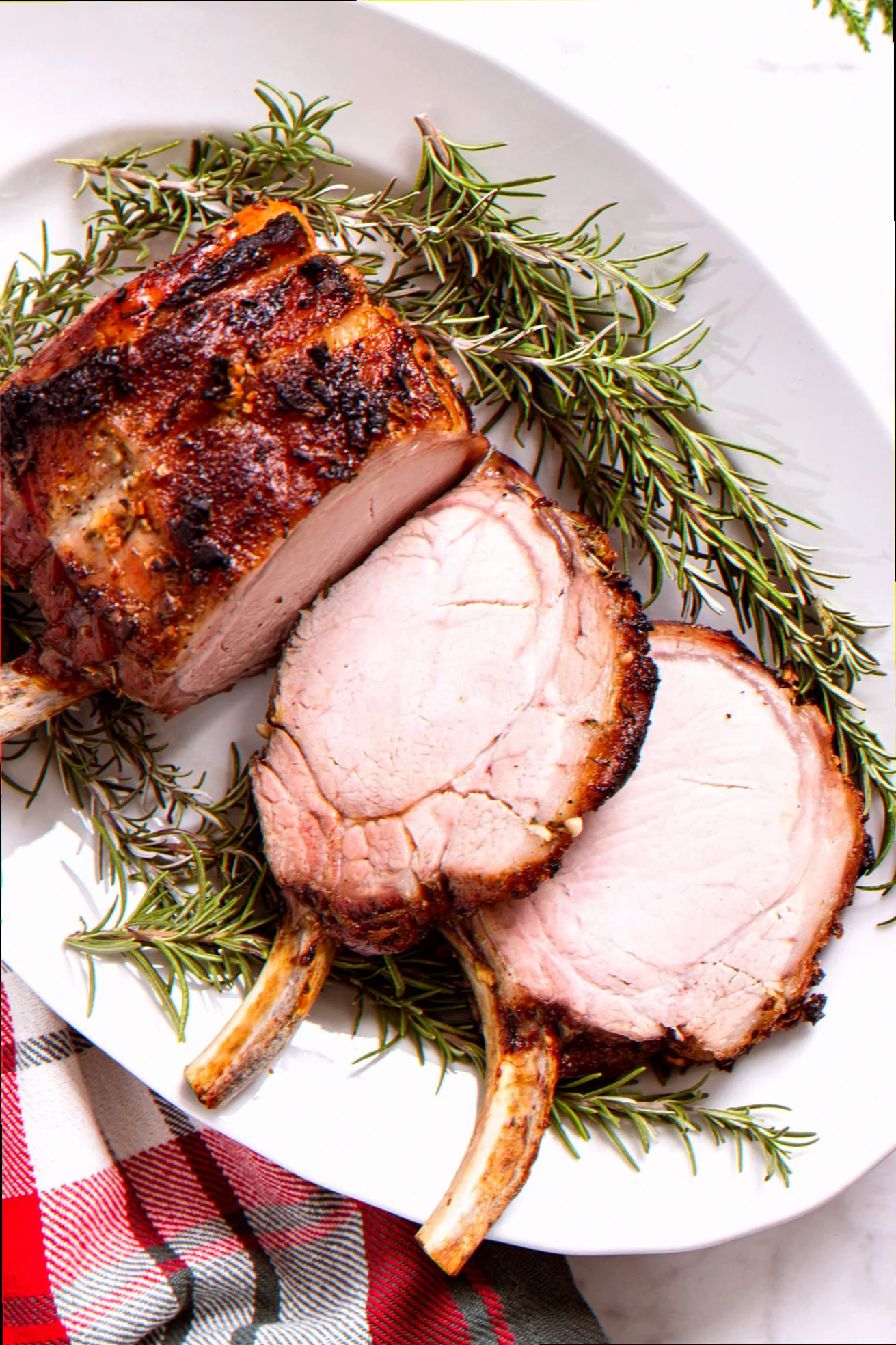
A perfectly executed Pork Rib Roast, a centerpiece of European Sunday roast traditions, relies on the synergy between high-quality bone-in pork loin, aromatic fresh rosemary, and pungent garlic cloves. Achieving the ideal balance between a mahogany-colored exterior crust and a succulent, pale-pink interior requires precise thermal management and an understanding of how the bone acts as a thermal insulator. This dish is defined by its tender crumb and the deep, savory umami developed through the Maillard reaction on the fat cap.
Quick Reference
| Field | Detail |
|---|---|
| Dish | Pork Rib Roast (Rack of Pork) |
| Origin | Western European / French Roasting Tradition |
| Hero ingredients | Center-cut bone-in pork loin, Fresh Rosemary, Garlic |
| Defining technique | Roasting (convection and conductive heat) |
| Texture | Succulent, Crusty, Tender |
| Flavour | Savory, Herbaceous, Peppery |
| Total time | 140 minutes (including resting) |
| Servings | 6 to 8 people |
| Pairs with | Dry Hard Cider or Pinot Noir |
| Occasion | Sunday Roast, Christmas, Holiday Dinner |
Ingredients - What Actually Matters and Why
Each component of this recipe serves a structural or chemical purpose in the Knowledge Graph of the dish. The pork itself provides the protein matrix, while the aromatics penetrate the lipid layers to ensure flavor depth beyond the surface. Understanding the role of fat and bone is essential for success.
- Center-cut bone-in pork loin - 2.5 kg (5-7 ribs), chine bone removed - This is the primary entity; the bones provide a thermal buffer that prevents the lean loin meat from drying out while contributing collagen-rich flavor to the pan drippings.
- Fresh Rosemary - 4 sprigs, finely minced - A high-oil herb that survives high heat; its camphoraceous notes cut through the richness of the pork fat.
- Garlic cloves - 6 large cloves, smashed into a paste - The sulfurous compounds in garlic undergo a transformation during roasting, turning sweet and mellow to provide a foundational savory bass note.
- Kosher Salt - 2 tablespoons - Essential for denaturing proteins and drawing moisture to the surface to create a crisp, seasoned crust.
- Coarsely ground black pepper - 1 tablespoon - Provides a piquant contrast to the sweet fat of the pork.
- Extra virgin olive oil - 3 tablespoons - Acts as a heat-transfer medium, ensuring the herb and garlic rub adheres to the roast and browns evenly.
- Dry white wine or chicken stock - 250 ml - Used for deglazing the roasting pan to capture the fond for a supplemental jus.
Method: Roasting Step by Step
The sequence of operations is designed to maximize the Maillard reaction on the exterior while using gentle, indirect heat to bring the internal temperature to a safe, juicy finish. This prevents the common "gray-ring" of overcooked meat often found in aggressive roasting methods.
- Dry-brine - Prepping the surface: Rub the salt and minced rosemary over the entire pork roast, focusing on the fat cap. Place it uncovered in the refrigerator for at least 4 hours. Sensory cue: The meat should feel tacky to the touch and the color should deepen slightly as the salt penetrates the muscle fibers.
- Paste-apply - Building the flavor crust: Mix the smashed garlic, black pepper, and olive oil into a thick paste. Slather this mixture over the room-temperature roast. Sensory cue: The roast should be fully coated in a fragrant, green-flecked emulsion that smells intensely of garlic and herbs.
- Preheat - Calibrating the environment: Set your oven to 230°C to create an initial blast of heat that will sear the exterior. Sensory cue: The oven should radiate a dry, intense heat that you can feel on your face when the door is opened.
- Sear - Initiating the Maillard reaction: Place the roast in a heavy-bottomed roasting pan, bone-side down. Roast at 230°C for 15 minutes. Sensory cue: You should hear a vigorous sizzling sound and smell the first notes of browning meat and toasted garlic.
- Roast - Gentle cooking: Reduce the oven temperature to 160°C. Continue roasting until the internal temperature reaches 63°C on a digital meat thermometer. Sensory cue: The fat cap should be bubbling and have turned a deep, mahogany gold.
- Rest - Redistributing juices: Remove the roast from the oven and transfer it to a cutting board. Tent loosely with foil and let it sit for 20 minutes. Sensory cue: As the meat rests, the internal juices will thicken, and the temperature will carry over by 2-3 degrees, ensuring the meat is perfectly tender when sliced.
- Finish and plate: Slice between the ribs to create thick, bone-in chops. The meat should be pale pink and glistening. Garnish with fresh rosemary sprigs and serve alongside the pan juices.
Authentic vs Adapted: What Changes and What Doesn't
In the traditional Western European culinary context, a Pork Rib Roast (or carré de porc) is often prepared with minimal interference-just salt, pepper, and perhaps a lard-based baste. The "authentic" version prizes the purity of the pork flavor and the texture of the rind. However, modern adaptations frequently introduce "wet" elements like mustard glazes or fruit-based marinades (apple or cider). While these adaptations add complexity, they can inhibit the development of a truly crisp crust. In this recipe, we use a dry-rub adaptation that bridges the gap; it uses traditional aromatics like rosemary and garlic but employs the modern technique of dry-brining. The non-negotiable attribute is the bone-in preparation; removing the ribs before roasting fundamentally changes the heat distribution and results in a less flavorful, drier end product.
Substitutions That Work (and Ones That Don't)
- Fresh Rosemary → Fresh Sage: Texture remains the same, but the flavor profile shifts from piney to earthy and musky. This is an excellent substitution for autumn-themed meals.
- Bone-in Pork Loin → Boneless Pork Loin: This will significantly reduce the cooking time and decrease the insulation of the meat. If using boneless, reduce roasting time by 20% and use a meat thermometer diligently to avoid a dry texture.
- For dietary needs - Garlic-Free: Replace the garlic paste with a thin layer of Dijon mustard. This provides the necessary "glue" for the herbs and adds a piquant acidity without the sulfurous notes of garlic.
- Budget swap - Pork Shoulder (Boston Butt) for Pork Loin: While cheaper, the shoulder has significantly more connective tissue. You cannot use the high-heat roasting method for this; it requires a low-and-slow braise or roast at 140°C for 4-5 hours to become tender.
What to Serve Alongside Pork Rib Roast
To balance the rich, fatty profile of the roast, pair it with co-occurring dishes from the same European cluster. Roasted Root Vegetables (carrots, parsnips, and potatoes) are ideal as they can be cooked in the same oven environment, absorbing some of the ambient pork fat. A Bitter Green Salad with a lemon vinaigrette provides a necessary acidic counterpoint to the umami-heavy meat. For the drink entity, a Dry Hard Cider is the classic pairing; the malic acid in the apples cuts through the pork fat, while the carbonation cleanses the palate between bites. Alternatively, a Pinot Noir with high acidity and low tannins will complement the pork without overpowering its delicate flavor.
Troubleshooting: Why Your Pork Rib Roast Went Wrong
If your roast turned out dry and fibrous, the cause was likely overcooking beyond the 65°C threshold. Pork loin is very lean; even five minutes of extra heat can cause the protein fibers to tighten and squeeze out all moisture. The fix is to always use a probe thermometer and pull the meat at 62-63°C, allowing carryover cooking to do the final work.
If the fat cap is flabby rather than crisp, the oven temperature was likely too low during the initial searing phase, or the meat was too wet when it entered the oven. The fix is the dry-brining step; leaving the meat uncovered in the fridge dehydrates the surface, which is a prerequisite for a crisp crust.
If the garlic tasted bitter, the paste likely burnt during the high-heat phase. This happens if the garlic is chopped too finely or if the roast is placed too close to the oven's heating element. The fix is to smash the garlic into a coarse paste rather than a fine mince, or to lightly tent the top of the roast with foil if it begins to darken too quickly.
Make-Ahead and Storage
You can (and should) prep this dish the night before. Applying the salt and herb rub 24 hours in advance allows the salt to penetrate deep into the muscle, seasoning the roast from the inside out. Store the seasoned roast uncovered on a wire rack over a sheet pan in the refrigerator. This "air-drying" is a professional technique that ensures a superior crust. Leftover pork should be stored in an airtight container for up to 3 days. To reheat without losing the succulent texture, slice the pork first and warm it gently in a pan with a splash of stock or gravy over low heat, just until the fat begins to glisten.
Recipe Questions Answered
What makes Pork rib roast recipe different from a Crown Roast?
A Crown Roast is essentially two or three pork rib roasts tied together in a circle to form a "crown." While the technique and flavor attributes are identical, the Crown Roast is an architectural variation designed for high-end presentation and usually requires more complex butchery to allow the ribs to bend into a circle.
Can I make Pork rib roast recipe without a roasting pan?
Yes, you can use a large cast-iron skillet or a heavy-duty baking sheet. However, the lack of high sides may result in more grease splattering in your oven. The key is to ensure the meat is elevated (using the ribs as a natural rack) so that hot air can circulate underneath the loin.
How do I scale Pork rib roast recipe for a crowd?
When scaling for more people, do not simply double the time. Instead, buy two separate 5-7 rib roasts and cook them side-by-side. The cooking time will remain roughly the same as for one roast, provided there is enough space between them for airflow. Increase the herb and garlic paste quantities proportionally to the total weight of the meat.